Introducing the Finny Ops Agent
A virtual back-office employee for modern funds. It starts with reconciliation, and it does not stop at a report.
By Nisarg
The hardest part of running a fund isn't always research. It's the back office: messy data, reconciliation breaks, manual follow-ups, and teams burning hours figuring out what changed and who needs to act. So we built something for it. Not a chatbot, not a dashboard, not another ETL pipeline. An agent that sits inside your environment, understands your workflows, and gets the right context to the right person at the right time.
The first wedge: reconciliation
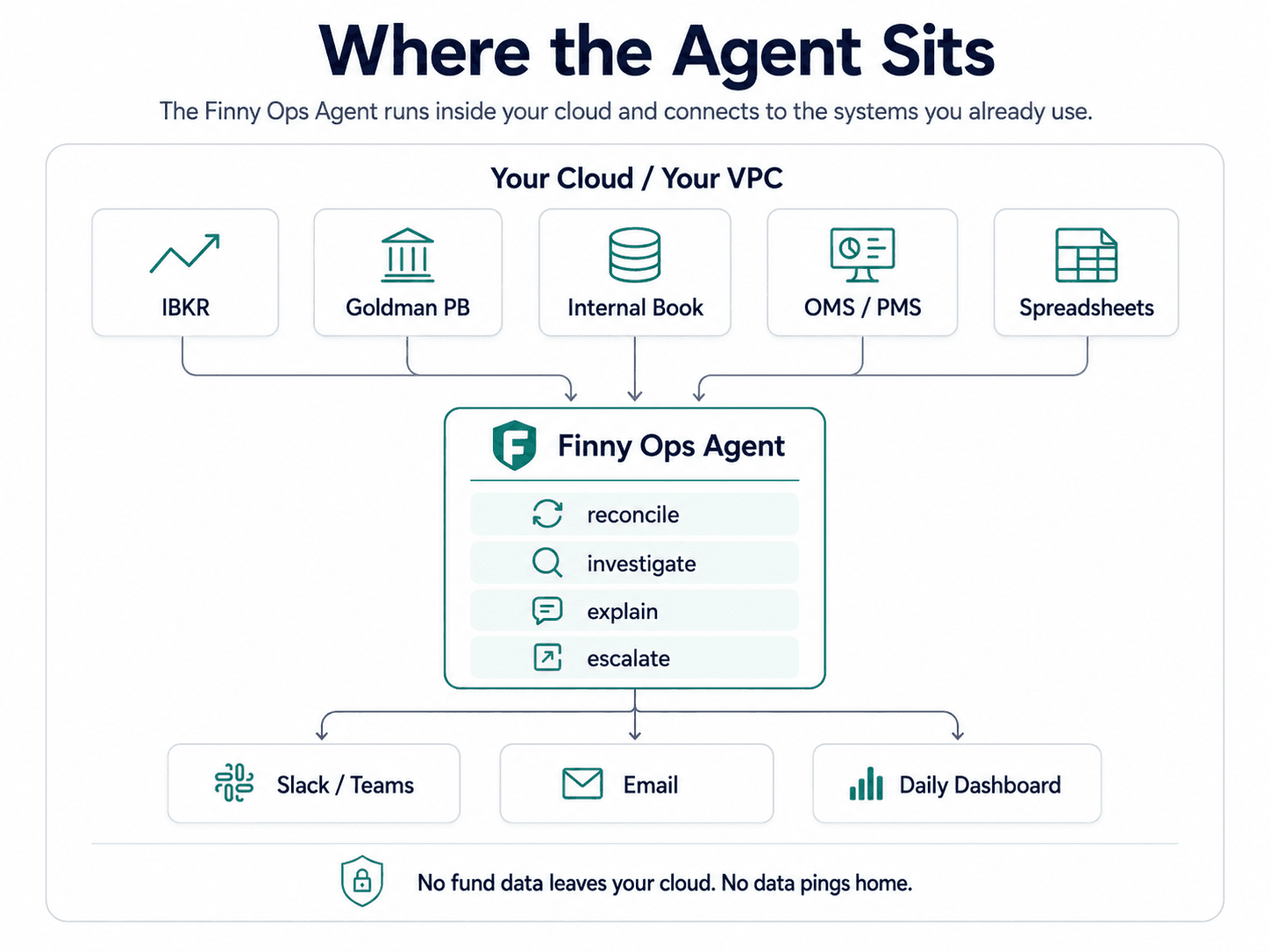
Every fund runs this workflow. Data arrives from prime brokers, internal books, OMS/PMS, spreadsheets, research platforms. Someone normalizes it, compares it, explains the breaks, and chases the right person down. The Ops Agent does that first: it brings the data together, matches positions, trades, cash, and fees, flags breaks, explains likely causes, and keeps an audit trail as it notifies whoever owns the fix.
But reconciliation is the entry point, not the ceiling. Once an agent understands your data, your recurring exceptions, and your escalation paths, the real question is what else it should be doing.
Where the agent sits
More than a report
A report that lands in an inbox and waits isn't the goal. The agent does the work around the information: it monitors a workflow, investigates an issue, explains what happened, and routes the follow-up. Ask it things like:
That's the line between a dashboard and a teammate: one shows you data, the other does something with it.
Knowing who needs to act next
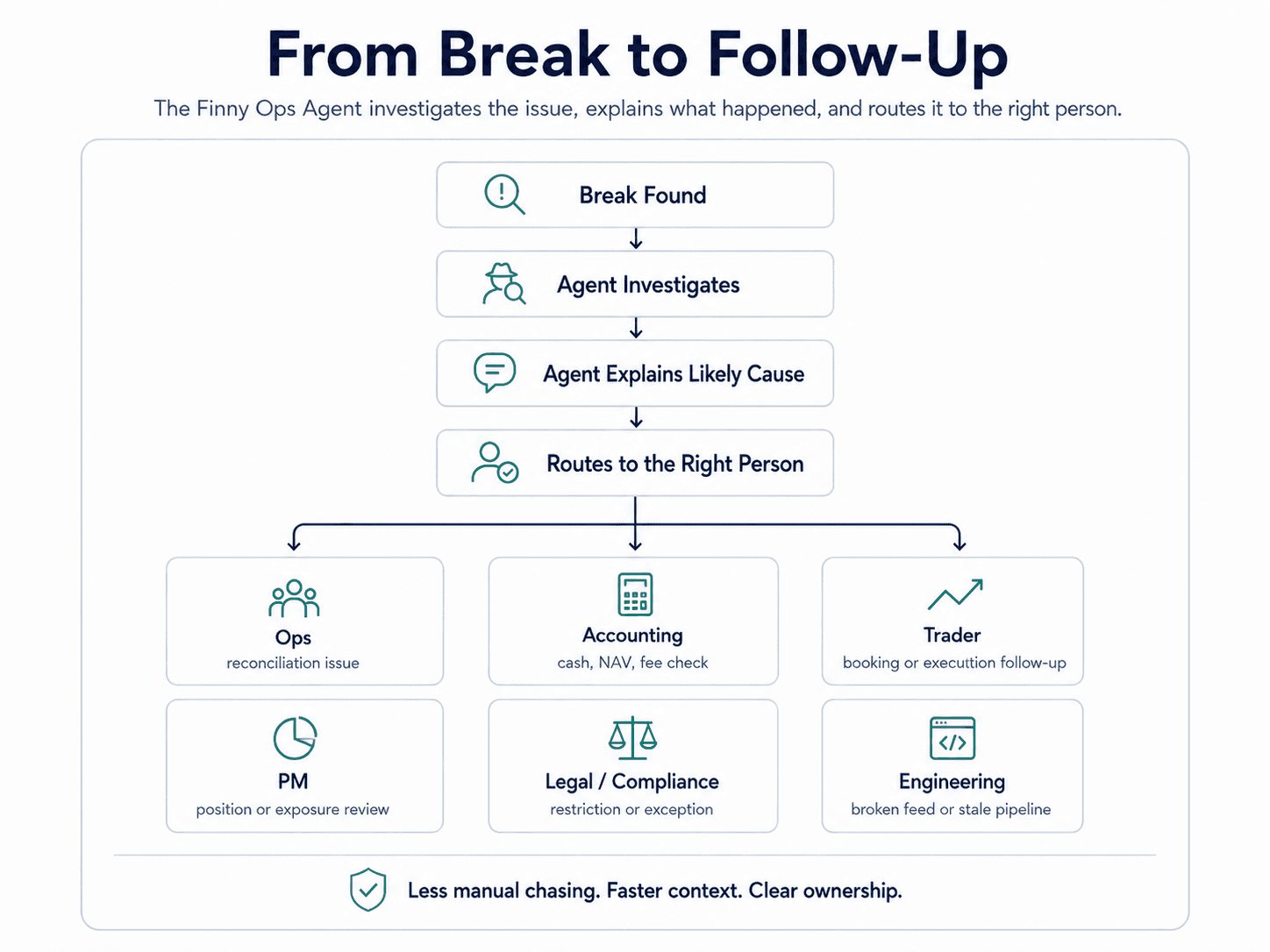
Finding the issue is rarely the hard part. Knowing who acts next is. Accounting reviews a fee or NAV item. Legal reviews a restriction. A trader chases a failed trade or counterparty mismatch. A PM checks exposure before the morning meeting. Engineering investigates a broken feed. The Ops Agent cuts out the coordination tax that shows up after an issue is already found.
Built to run where your data lives
For funds, data privacy is not a feature. It is a requirement. The Ops Agent runs inside your own cloud or VPC, connects only to systems you approve, and follows your permission model end to end.
We're looking for Design partners
This is an early product direction, and we want funds to help shape it. We're starting with reconciliation because it's clear, painful, and high-value, but the best automations are usually hiding inside the daily work nobody talks about. Tell us where your team loses the most time, which checks are still too manual, and what you'd actually trust an AI ops employee to own.
If that's you, reach out or book a call.